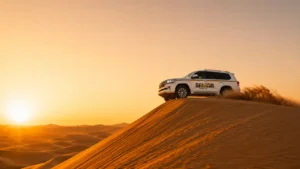
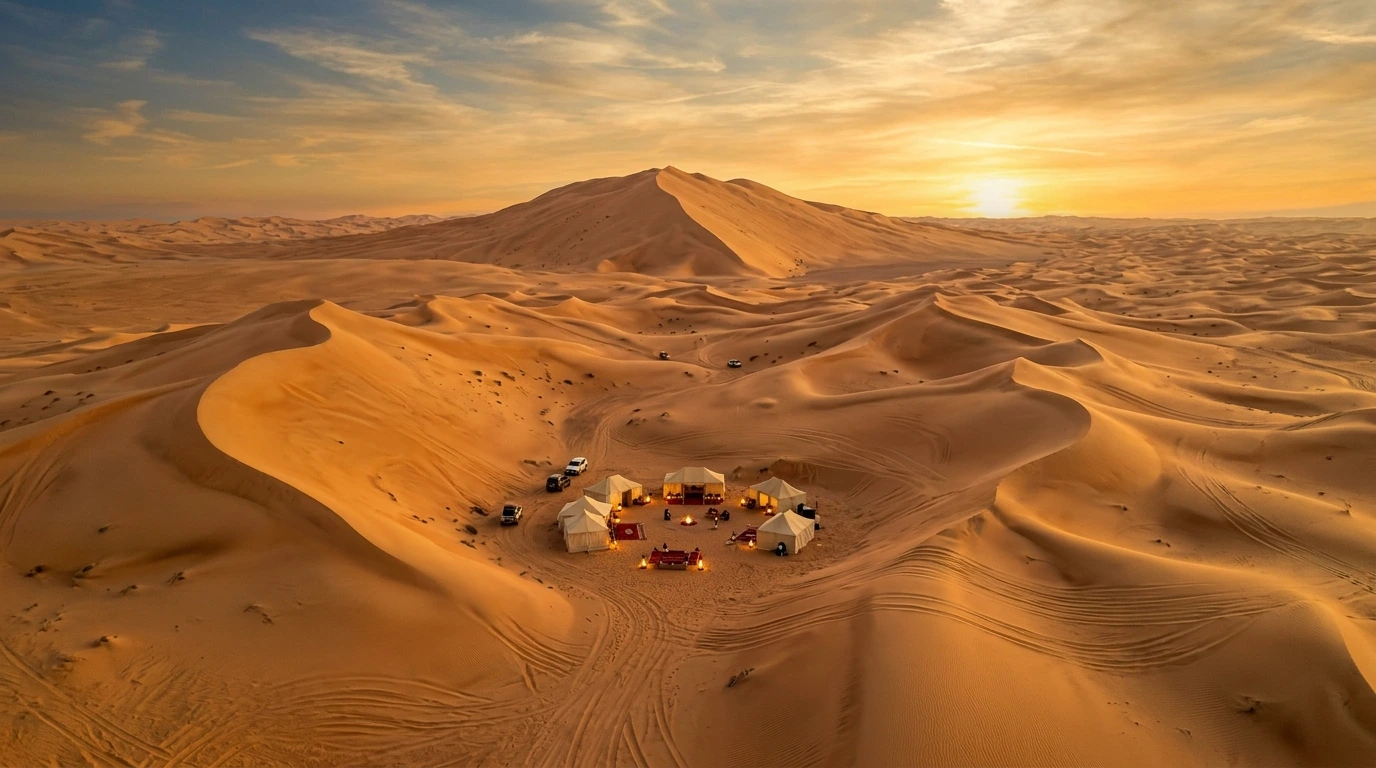
A Liwa Desert Safari Abu Dhabi trip is not something to squeeze between a museum visit and dinner. Liwa sits far beyond the safari areas close to the capital, so the drive alone can take five to six hours in total. In return, you get taller dune systems, long open views and access to the UAE side of the Rub’ al Khali, or Empty Quarter.
That distance is also why accurate planning matters. Two tours with the same name may offer very different amounts of dune time, different Tal Moreeb stops and completely different overnight setups. Sahara Thrills plans desert experiences across Abu Dhabi, and this guide explains the practical details travellers need to check before choosing Liwa.
Key Takeaways
- A Liwa Desert Safari Abu Dhabi trip normally needs a full day because the Liwa region is roughly 2.5 to 3 hours from Abu Dhabi city each way.
- Tal Moreeb, also written Tel Moreeb, rises more than 300 metres and has an incline of about 50 degrees. A normal tour may stop at its base or a viewpoint; it does not automatically include driving up the competition face.
- Main landmarks can be reached on paved roads, but entering the dunes is different. Remote off-road driving needs a capable 4×4, an experienced driver, recovery equipment and preferably a convoy.
- October to April is the most comfortable season for outdoor time. Winter nights can feel cold, while summer heat can shorten or change activities.
- Before paying, confirm the exact pickup area, road time, private or shared vehicle, Tal Moreeb stop, meals, child-seat arrangements, health restrictions and overnight camp facilities.
What Is a Liwa Desert Safari Abu Dhabi Experience?
A Liwa desert safari is a guided full-day or overnight trip from Abu Dhabi into the Liwa region on the northern edge of the Empty Quarter. It usually combines a long road transfer with guided dune driving, landscape stops and selected activities such as sandboarding, a camel-farm visit or camping.
Liwa is more than one dune or one oasis stop. It is a broad desert region with settlements, date-growing areas, forts, paved roads and access points into much more remote sand terrain. The exact route matters, so “Liwa included” is not a complete itinerary by itself.
A typical guided tour may include:
- Pickup and drop-off in an air-conditioned 4×4
- A long road drive from Abu Dhabi city into Al Dhafra
- Tyre-pressure adjustment before off-road driving
- Guided dune driving or dune bashing at a level suited to the group
- A Tal Moreeb viewpoint or base-area stop
- Sandboarding, best desert photography ways or a camel-farm visit
- Lunch, water and soft drinks on a full-day route
- Sunset, dinner, camping, stargazing, sunrise and breakfast on selected overnight routes
Activities are not universal. Camel rides, forts, oasis stops, meals, entertainment and private camp facilities must be listed in the written package if they matter to you.
See how dune driving, sandboarding, camel rides with a guide and camp experiences differ in our guide to Abu Dhabi desert safari activities.
How Is Liwa Different From a Regular Abu Dhabi Desert Safari?
Unlike regular city-edge safaris, Liwa focuses on remote landscapes, towering dunes and longer exploration rather than evening entertainment.
| Experience | Common total duration | Main appeal | Typical format | Main trade-off |
| City-edge Abu Dhabi safari | About 4–7 hours | Convenient dune ride, sunset and camp activities | Morning or evening | Less remote and smaller time commitment |
| Full-day Liwa safari | About 9–12 hours | Empty Quarter scale, Tal Moreeb and long desert views | Early pickup, road transfer, guided dune route and return | Five to six hours may be spent on the road |
| Overnight Liwa safari | About 18–24 hours | Sunset, quiet night, stargazing and sunrise | Full-day route plus camp, dinner and breakfast | Higher cost and camp comfort varies |
These are planning ranges, not promises. Pickup location, traffic, weather, the chosen dune route and the number of stops can change the day.
If you only have one free evening, a closer safari will usually make more sense. If the Empty Quarter is one of the main reasons for visiting Abu Dhabi, Liwa is the stronger choice. Use the morning vs evening vs overnight desert safari comparison to match the format to your available time.
How Far Is Liwa Desert From Abu Dhabi?
Liwa is generally around 2.5 to 3 hours from Abu Dhabi city by road, depending on the pickup point and the exact destination in the Liwa region. The official Liwa festival guidance advises allowing about three hours from Abu Dhabi.
The useful question is not only “How far is Liwa?” It is “How much of my booked tour is road travel, and how much is actual desert time?” A full-day Liwa trip can include roughly five to six hours of round-trip road travel before comfort stops, meals and activities are counted.
An Illustrative Full-Day Schedule
The schedule below shows how a well-paced day may work. It is not a fixed Sahara Thrills itinerary.
| Approximate time | What may happen |
| 7:00–8:00 AM | Pickup from an agreed Abu Dhabi location |
| 9:30–10:30 AM | Arrival in the Liwa region, comfort stop and desert preparation |
| Late morning | Guided dune drive, viewpoints and photo stops |
| Early afternoon | Lunch and refreshments |
| Afternoon | Tal Moreeb, sandboarding, camel farm, oasis or fort stop if included |
| Late afternoon | Return drive begins, or the overnight route continues toward camp |
| 6:30–8:00 PM | Typical city return window for some full-day routes |
Sunset-focused trips may leave later and return later. If a tour from Abu Dhabi is advertised as only six hours, ask for the time breakdown. It may allow little time in the dunes, start from a location closer to Liwa or use “Liwa” more loosely than you expect.
What Makes Tal Moreeb Worth Visiting?
Tal Moreeb is worth visiting for its scale, long dune face and place in Abu Dhabi’s winter motorsport culture. Official Abu Dhabi tourism information describes it as more than 300 metres high with an incline of about 50 degrees.
You may see the name written as Tal Moreeb, Tel Moreeb, Moreeb Dune or Moreb Dune. Search engines and tour operators use several English spellings for the same landmark.
What a Tal Moreeb Stop Usually Means
A Tal Moreeb stop normally means visiting the landmark area, base or an agreed viewpoint. It should not be read as a promise that a passenger safari vehicle will climb the dune’s steep competition face.
The main landmark area is accessible by paved road, while larger dunes and remote areas require a 4×4. During organised motorsport events, specialist drivers and vehicles use controlled routes that are not the same as an ordinary sightseeing safari.
Ask the operator one precise question before booking:
When you say Tal Moreeb is included, is it a base stop, a viewpoint, a nearby sandboarding stop or part of the guided off-road route?
That answer tells you more than a long list of generic “highlights.” Learn what dune bashing involves, including vehicle preparation, ride comfort and safety.
Check the measurements and destination overview on the official Tal Moreeb visitor page.
Full-Day, Sunset or Overnight Liwa Safari: Which Should You Choose?
Choose a full-day safari for the most practical first visit, a sunset route for photography and an overnight trip for the complete dusk-to-dawn experience. Your available time and tolerance for long road travel should decide the package.
| Tour type | Best for | What to expect | Check before booking |
| Full-day Liwa safari | First-time Liwa visitors, landscape lovers and active families | Daylight dune route, Tal Moreeb area, selected oasis or camel stops and lunch | Exact road time, lunch type, guaranteed stops and return window |
| Sunset-focused Liwa safari | Couples and photographers | Later light, dune views and a sunset stop | Whether the trip still includes Tal Moreeb and how late the city return will be |
| Overnight Liwa safari | Stargazers, couples, residents and slow-travel guests | Sunset, dinner, tented stay, sunrise and breakfast | Tent type, bathrooms, bedding, power, camp occupancy and meal details |
| Private Liwa safari | Families, photographers and groups wanting pace control | Exclusive vehicle and more flexibility for stops | What is flexible and what remains fixed for safety or route conditions |
Choose a Closer Abu Dhabi Safari Instead If…
Liwa is not automatically the best safari for every traveller. A closer route may suit you better if:
- You only have a morning or evening free
- Someone in the group struggles with long car rides
- Your main priorities are a BBQ buffet and live camp shows
- You are travelling with a very young child and the operator cannot provide the correct restraint
- You need step-free facilities or predictable bathroom access
- A medical condition rules out dune driving and no scenic alternative is available
Choosing the right desert is better than choosing the biggest name.
For a wider overview of tour types, read the complete desert safari in Abu Dhabi guide, which covers every single option for you.
What Is an Overnight Liwa Desert Safari Really Like?
An overnight Liwa desert safari extends the day beyond sunset, but the sleeping experience depends entirely on the camp. “Overnight” can describe a simple mobile tent, a fixed shared camp, a private camp or a resort-style glamping setup.
The usual flow is sunset, dinner, a quieter period after the day vehicles leave, sleep, sunrise and breakfast. Clear skies can be excellent for stargazing, but cloud, dust, humidity and moonlight affect visibility. No operator can guarantee a visible Milky Way on every date.
Ask These Camp Questions Before You Pay
| Camp detail | What to confirm |
| Sleeping space | Private or shared tent; maximum occupants; standing room; lock or closure |
| Bedding | Mattress thickness, sheets, pillow, blanket and whether guests need a sleeping bag |
| Temperature control | Fan, heater or air-conditioning; whether power runs all night |
| Bathrooms | Fixed or portable toilets; shared or private; running water; shower availability |
| Meals | Dinner and breakfast menu; halal, vegetarian, vegan and allergy arrangements |
| Electricity | Charging points, generator hours and whether a power bank is needed |
| Mobile signal | Likely coverage at the exact camp; offline maps and emergency contact plan |
| Privacy and noise | Number of guests, nearby camps and whether a festival is taking place |
| Morning plan | Sunrise wake-up time, breakfast and expected Abu Dhabi drop-off |
Do not assume “luxury,” “Bedouin-style” or “private” answers these questions. Ask for current camp photos and written inclusions. For more detail, see the overnight desert safari Abu Dhabi guide to sleeping arrangements, bathrooms, meals, stargazing and packing.
What Is Included in a Liwa Desert Safari Package?
Most Liwa packages include transport, a guide, water and some form of guided desert driving, but the rest varies widely. Treat every unlisted activity as excluded until the operator confirms it in writing.
| Often included | Must be confirmed |
| Abu Dhabi pickup and drop-off | Exact pickup zones and any Yas Island, Saadiyat, airport or Dubai surcharge |
| Air-conditioned 4×4 | Private or shared vehicle and maximum passenger count |
| Driver-guide | Driver’s desert experience, safety briefing and language |
| Guided dune drive | Duration, intensity and whether a gentle scenic option is available |
| Drinking water | Quantity, soft drinks and refill plan |
| Photo stops | Exact Tal Moreeb, oasis, fort or camel-farm stops |
| Some meals on longer tours | Restaurant, picnic or camp buffet; dietary arrangements |
| Selected activities | Sandboard, camel ride, quad bike or other equipment and fees |
| Overnight basics on camping tours | Tent, bedding, toilets, power, dinner and breakfast |
What Packages Does Sahara Thrills Currently Offer for Liwa?
Sahara Thrills offers full-day and overnight Liwa options from Abu Dhabi. Its full-day outline includes private air-conditioned 4×4 transport, guided dune driving, a Tel Moreeb stop, sandboarding, a camel ride, a picnic-style lunch, water and soft drinks. The overnight outline continues with camp, dinner, sunrise and breakfast.
Routes and outdoor activities can still change with weather, access and safety conditions, so confirm the final written itinerary for your date.
Overnight Desert Safari |
Private Overnight Desert Safari |
|
|
| From AED 400 | Per Person | From AED 2500 |
Let’s review current availability, inclusions and quotes on the Sahara Thrills Liwa desert safari packages page.
How Much Does a Liwa Desert Safari Cost Usually?
There is no useful single price for a Liwa desert safari because operators sell packages in different ways. One headline price may be per person in a shared vehicle, while another may cover a private 4×4 for the whole group.
Price is mainly affected by:
- Shared per-person booking versus a private per-vehicle rate
- Number of adults and children
- Pickup from Abu Dhabi, Dubai or another area
- Full-day, sunset or overnight duration
- Simple camping, fixed camp or glamping accommodation
- Meals, private dining and dietary requests
- Sandboarding, camel rides, quad bikes and other add-ons
- Festival dates, weekends and peak winter demand
- Taxes, booking fees and cancellation terms
Ask for the final total for your whole group, then request a line-by-line list of inclusions and exclusions. A cheaper quote is not better if it removes Tal Moreeb, lunch, a private vehicle or the camp facilities you expected.
When Is the Best Time for a Liwa Desert Safari?
October to April is the best general window for a Liwa desert safari because outdoor activities and camping are more comfortable. The official Liwa International Festival guidance also recommends this period for cooler conditions.
| Period | What it feels like | Best use |
| November to March | Coolest and busiest part of the season; nights may feel cold | Full-day tours, camping and longer outdoor stops |
| October and April | Warmer shoulder months with fewer peak-season pressures | Early starts, sunset routes and flexible private trips |
| May to September | Strong daytime heat; outdoor time may be shortened or moved | Carefully timed trips for heat-tolerant guests only |
Pick the Date, Not Just the Month
Weather, wind and visibility can change a desert route at short notice. Check the forecast and keep the operator’s contact details available on the day.
For stargazing, a darker moon phase usually reveals more stars, while a bright moon lights the dunes but washes out faint objects. Choose based on whether your priority is night-sky detail or moonlit landscape photography.
The annual Liwa International Festival changes the atmosphere around Tal Moreeb. Festival periods bring motorsport, entertainment, more services, traffic and noise. Visit during the event if that energy is part of the appeal; choose a quieter date if silence and an uncrowded camp matter more.
Before choosing a date, check the official Liwa trip-planning guidance for seasonal advice, festival information and travel preparation.
Is a Liwa Desert Safari Safe for Children and Adults?
A guided Liwa safari can be suitable for many families and adults when the vehicle, restraints, driver and route match the group. The long transfer and stronger dune terrain mean health and comfort must be discussed before booking, not after pickup.
Children and Vehicle Restraints
Ask for the operator’s minimum age for dune bashing because policies differ. Also give every child’s age, height and weight so the correct seat can be confirmed.
UAE traffic rules require a child seat for children under four. They also prohibit children under ten, or shorter than 145 centimetres, from sitting in the front seat. All passengers must wear seat belts. Confirm that the required restraint is installed before the vehicle leaves.
Check the current UAE Government road-safety guidance before travelling with children.
Who Should Avoid Dune Bashing?
Dune bashing is commonly unsuitable for pregnant guests and may not be appropriate for people with serious back or neck conditions, recent surgery, heart problems or severe motion sickness. Older age alone does not decide suitability; health, mobility and ride intensity matter more.
Tell the operator about concerns before paying. Ask whether the guest can use a paved scenic route, skip the dune section or meet the group at an accessible stop. Seek medical advice if you are unsure whether the motion is appropriate for a specific condition.
Practical Safety Checks
Before entering the dunes, make sure:
- Every passenger has a working seat belt and the right child restraint
- Loose bags and hard objects are secured
- The guide knows about motion sensitivity and mobility limits
- The ride intensity has been agreed
- Water and necessary medication stay inside the passenger area
- The operator has a communication and recovery plan for the remote route
- Weather or access changes can be made without pressure to follow the original schedule
Can You Self-Drive to Liwa Without a 4×4?
You can reach several Liwa settlements and main landmarks on paved roads without driving into the dunes, but off-road Liwa travel is a separate activity. A normal road car reaching the Tal Moreeb area does not make that car suitable for sand driving.
| Plan | Vehicle and experience needed | Main caution |
| Paved-road sightseeing | A roadworthy vehicle may be enough for main roads and selected landmarks | Wind-blown sand, long distances and limited services still require preparation |
| Guided Liwa safari | No passenger off-road experience is needed | Choose a reputable operator and disclose health or child-seat needs |
| Self-drive into the dunes | Capable 4×4, desert-driving skill, recovery gear, offline navigation and a convoy | Getting stuck, cresting a dune, losing the route and invalidating rental or insurance terms |
Official Liwa visitor guidance recommends a 4×4 for larger dunes and remote areas, a well-checked vehicle and travelling in a convoy. It also warns that amenities are limited and mobile service can weaken in remote sections.
If you are considering self-drive dune travel:
- Check the rental contract and insurance for off-road exclusions
- Travel with experienced desert drivers, not as a single vehicle
- Carry more water than the planned drive requires
- Bring a tyre gauge, compressor and suitable recovery equipment
- Download offline maps and share the route and return time with someone outside the group
- Stay on permitted routes and follow current signs or closures
- Turn back early if wind, heat, visibility or vehicle condition worsens
First-time visitors should use a guided safari for the off-road section. You can still enjoy a separate paved Liwa road trip without treating it as a dune-driving exercise.
What Should You Wear and Bring to Liwa?
Wear breathable layers, long comfortable trousers and secure shoes, then carry sun protection and a warm layer for the evening. Liwa is remote enough that a few small items can prevent a minor problem from spoiling a long day.
| Item | Why it helps |
| Light, breathable top | Keeps daytime travel more comfortable |
| Loose trousers | Protects skin from sun, hot sand and seat friction |
| Closed shoes with socks | Gives better support for sandboarding and walking after dark |
| Warm layer | Helps after sunset and on winter mornings |
| Hat and UV-protective sunglasses | Reduces sun and glare exposure |
| Broad-spectrum sunscreen and lip balm | Protects exposed skin in dry conditions |
| Personal medication | Remote stops may be far from a pharmacy |
| Water and light snacks | Useful even when refreshments are included |
| Charged phone, power bank and cable | Supports navigation, photos and communication |
| Small flashlight or headlamp | Essential around an overnight camp after lights are reduced |
| Wipes, tissues and toiletries | Facilities vary by route and camp |
| Zip pouch or lens cloth | Keeps sand away from a phone, camera and spare batteries |
For an overnight stay, add warm sleepwear, spare socks, toothbrush, any required hygiene products, an eye mask and earplugs. Ask whether towels, pillows and blankets are supplied before packing bulky bedding.
Desert Etiquette and Environmental Rules
Respecting the route, people and landscape is part of a safe Liwa visit. The desert can look empty while still containing wildlife, farms, private areas, fast-moving off-road vehicles and fragile ground.
- Stay close to the guide and tell them before walking over a dune ridge. A driver on the other side may not see you.
- Ask before photographing local people, private camps or workers at a camel farm.
- Dress respectfully at settlements, farms, family camps and cultural sites.
- Do not feed or chase wildlife.
- Take every piece of waste out with you and use toilets where provided.
- Use fire only where the operator or campsite permits it, keep it contained and make sure it is fully extinguished.
- Do not assume a drone can be flown in the area. Check current UAE aviation rules and location restrictions before carrying or launching one.
- Follow marked access routes, temporary closures and event instructions.
The Liwa Safari Booking Checklist
Ask these questions before paying for any Liwa desert safari from Abu Dhabi:
- What are the exact pickup and expected return windows for my hotel?
- Is the quoted rate per person or for the whole vehicle?
- Is the 4×4 private or shared, and how many passengers will it carry?
- How much time is road transfer, and how much is guided desert activity?
- What does the Tal Moreeb stop include: base, viewpoint or off-road section nearby?
- Which oasis, fort, camel-farm, sandboarding or photo stops are guaranteed?
- What vehicle restraints are available for each child’s age, height and weight?
- Can dune intensity be reduced, or can a guest skip the off-road section?
- Which meals, drinks, equipment, taxes and pickup surcharges are included?
- For overnight tours, what are the exact tent, bedding, toilet, shower and power arrangements?
- What happens if wind, heat, visibility, road access or a festival changes the route?
- What are the cancellation, refund and late-return terms?
A reliable operator should answer these in writing. Save the final itinerary and contact number on your phone before departure.
Is a Liwa Desert Safari Worth It?
A Liwa desert safari is worth it when the Empty Quarter itself is the goal and you can give it a full day. The long transfer feels justified for travellers who value huge dune landscapes, fewer city-edge distractions, Tal Moreeb and the option to stay through sunset and sunrise.
It is less suitable for a rushed stopover or anyone expecting a short evening safari with maximum camp entertainment. In that case, choose a closer Abu Dhabi route and save Liwa for a trip with more time.
For current Sahara Thrills options, compare the full-day and overnight details, then confirm the route, camp setup and final group price before booking. The team can also answer date-specific health, child-seat and accessibility questions before you pay.
Frequently Asked Questions
Here are the FAQs about Liwa Desert Safari Abu Dhabi.
Is a Liwa Desert Safari worth it?
Yes, if you want the Empty Quarter’s large dune landscapes and can spare a full day. Liwa offers a more remote setting than safari areas close to Abu Dhabi city. It may not suit a short stopover, travellers who dislike long drives or guests mainly seeking evening camp entertainment.
Do I need a 4×4 to visit Liwa and Tal Moreeb?
Main Liwa roads and selected landmarks, including the Tal Moreeb area, can be reached by paved road. A capable 4×4 is required for dune and remote-area driving. First-time off-road visitors should book a guided safari; experienced self-drivers should travel prepared, check insurance terms and use a convoy.
What is the best time for a Liwa desert safari?
October to April is the most comfortable period for a Liwa safari, with November to March usually offering the coolest conditions. Summer trips need careful timing because daytime heat can limit outdoor activity. Overnight visitors should bring layers, and stargazers should also check the moon phase and forecast.
Can children join a Liwa desert safari?
Children can join many Liwa tours, but the operator’s dune-bashing age policy and the long road transfer must suit the child. Give the operator each child’s age, height and weight before booking. Confirm the correct child restraint, a gentler ride option, meal needs and regular comfort stops.
What is included in an overnight Liwa desert safari?
An overnight package commonly includes Abu Dhabi transfers, guided dune driving, sunset, dinner, a tented stay, breakfast and sunrise. Camp standards vary, so confirm whether the tent is private, which bedding is supplied, what toilets or showers are available, whether power runs overnight and which activities are included.
How much does a Liwa Desert Safari cost?
A private Liwa Desert Safari generally costs between AED 1,400 and AED 2,800 per vehicle, usually accommodating four to six guests. Since the Empty Quarter (Rub’ al Khali) is approximately 2.5 hours from Abu Dhabi city, most Liwa tours are offered as private packages rather than shared trips. Prices vary depending on the tour duration, activities, meals, and overnight options.
Which desert safari is better: Dubai or Abu Dhabi?
The better choice depends on the experience you prefer. Dubai desert safaris are known for energetic entertainment, convenient travel times, and striking red dunes. Abu Dhabi safaris generally offer larger, quieter landscapes, fewer crowds, and a more peaceful and traditional desert experience. Choose Dubai for lively entertainment or Abu Dhabi for scenery and tranquillity.
Is entry to the Liwa Festival free?
General entry to the Liwa International Festival and public areas around Moreeb Dune is usually free. Visitors can explore the main grounds, watch many heritage and desert-sports competitions, and use standard parking without purchasing a ticket.
However, some attractions require payment, including selected Liwa Village zones, special arena shows, amusement rides, VIP areas, premium hospitality packages, and certain concerts or motorsport events.
What is the best time to visit Liwa?
The best time to visit Liwa is between October and April, when the weather is cooler and more comfortable for outdoor activities. Daytime temperatures during this period are commonly between 20°C and 30°C, while evenings can be pleasantly cool. These months are ideal for desert safaris, dune bashing, sightseeing, and overnight camping.
How far is Liwa from Abu Dhabi?
Liwa is approximately 220 to 250 kilometres south of Abu Dhabi city. The journey usually takes between two and three hours by car, depending on your starting point, traffic conditions, and the specific destination you are visiting within the Liwa Oasis region.
What can you see in Liwa, Abu Dhabi?
Liwa Oasis is famous for its enormous red-gold dunes, green date-palm groves, historic forts, and dramatic Empty Quarter scenery. Popular attractions include Moreeb Dune (Tal Moreeb), the Rub’ al Khali, traditional camel farms, historic watchtowers, desert settlements, and seasonal cultural festivals. The area also hosts exciting dune-driving and motorsport events.
What are the dates for the Liwa Village Festival in 2026?
The 2025–2026 edition of Liwa Village, held as part of the Liwa International Festival, ran from December 12, 2025, to January 3, 2026. It took place near Moreeb Dune in Abu Dhabi’s Al Dhafra Region and featured cultural activities, food, music, shopping, and entertainment across several themed zones. Official dates for the late-2026 or 2026–2027 edition have not yet been announced.