
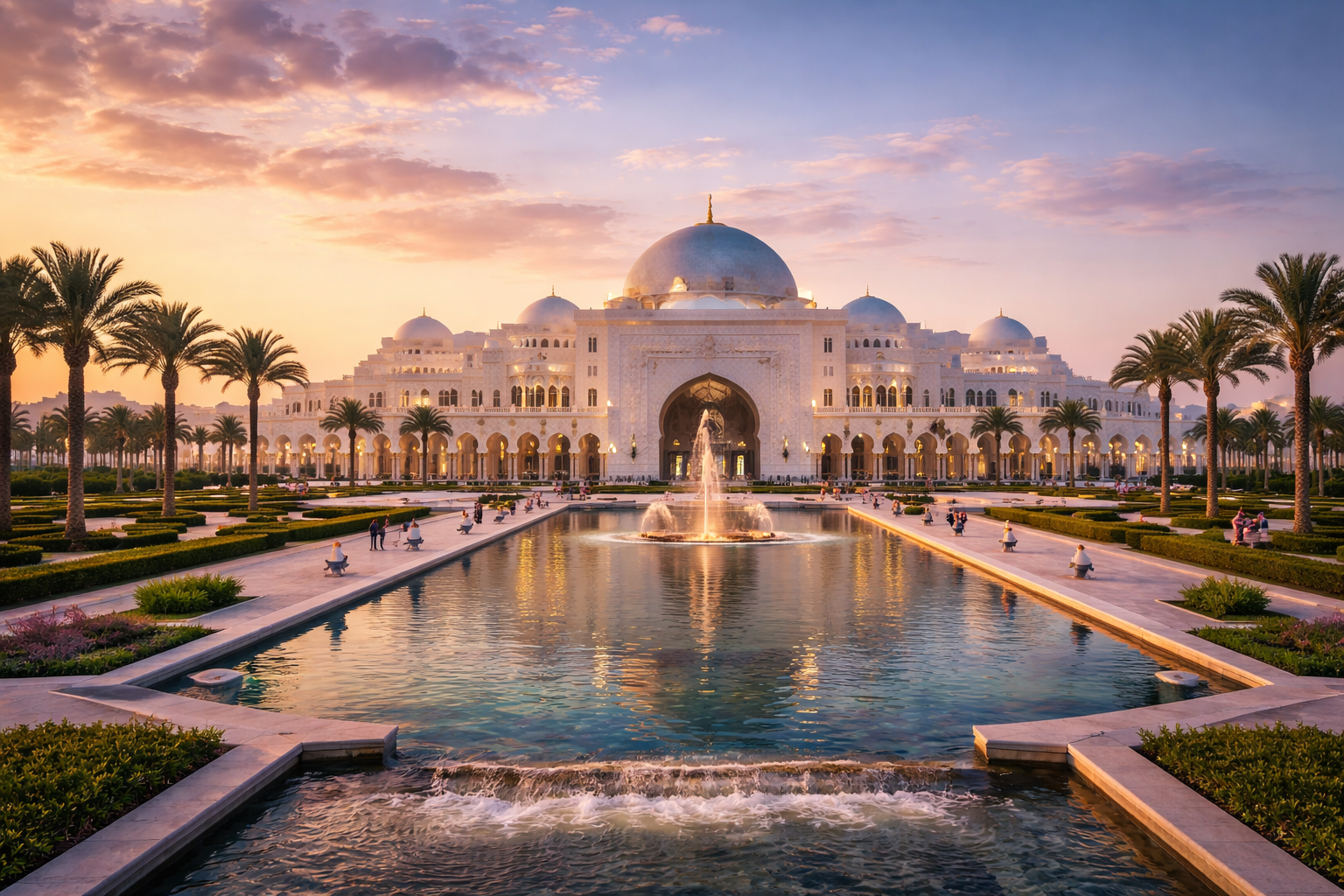
Abu Dhabi does not announce itself loudly. It does not need to. From the moment you see the Sheikh Zayed Grand Mosque’s white marble domes shimmering against a sapphire Gulf sky, you understand that this city operates on a different level entirely, one where grandeur is quietly expected, and beauty is simply the standard.
Most first-time visitors to the UAE land in Dubai and never make it here. That is their loss, and honestly, it is your opportunity. Abu Dhabi, the UAE capital, sits just 90 minutes from Dubai and packs in world-class museums, pristine island beaches, ancient forts, family-friendly theme parks, and one of the most spectacular desert landscapes on earth. According to the Visit Abu Dhabi tourism authority, the emirate welcomed over 24 million visitors in 2023, and numbers have climbed steadily since.
Whether you are travelling solo, with a partner, or wrangling a family of five with different opinions about what counts as fun, Abu Dhabi has an answer for every one of them. This guide covers every corner of it, including the spots that most listicles never bother mentioning.
Why Abu Dhabi Is a Must-Visit Destination
Abu Dhabi is the largest emirate in the UAE, covering approximately 87% of the country’s total land area, yet it carries none of the overcrowded, over-hyped energy that can exhaust visitors in busier cities. Instead, it offers something rarer: space, depth, and authenticity woven through with genuine luxury.
Culture sits at the city’s core in a way that is tangible, not performative. You will find Emirati heritage thoughtfully preserved in museums, living heritage villages, and centuries-old forts standing steps from futuristic skylines. The Corniche stretches for eight kilometres of Gulf-front walkway without a single building blocking the breeze. Islands like Saadiyat and Yas offer two entirely different energy levels within a 20-minute drive of each other.
Then there is the desert. Abu Dhabi’s desert, stretching south into the vast Rub’ al Khali is on a scale that Dubai’s desert cannot match. These are proper dunes: towering, cinematic, and utterly humbling.
Who should visit Abu Dhabi?
- Families: Theme parks, beaches, and safari experiences that work for all ages
- Couples: Romantic Corniche walks, island sunsets, and desert stargazing
- Solo travellers: Cultural depth, walkable waterfronts, and a city genuinely safe to explore alone
- Culture seekers: World-class museums and living heritage at every turn
Iconic & Must-See Attractions in Abu Dhabi
Sheikh Zayed Grand Mosque
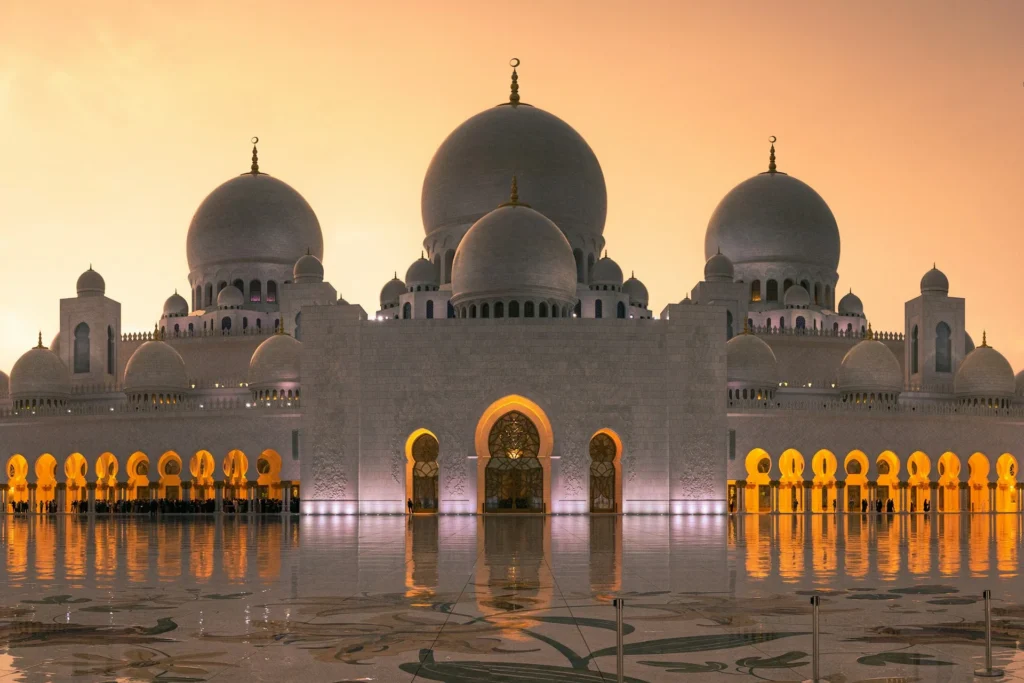
There is no single building in the Arabian Peninsula more photographed, more discussed, or more genuinely deserving of its reputation than this one. The Sheikh Zayed Grand Mosque is one of the world’s largest mosques, built from 82 varieties of white marble sourced across four continents, capable of holding more than 40,000 worshippers, and home to the world’s largest hand-knotted carpet, which took 1,200 artisans two years to complete.
What strikes you first is the scale. What stays with you is the detail, 82 domes, 1,000 columns, 24-carat gold-plated chandeliers, and a courtyard that reflects the mosque’s minarets in a shallow pool that turns golden at sunset. Entry is free for visitors, modest dress is required (abayas are available to borrow at the gate), and non-Muslim visitors are genuinely welcome.
Visitor tips:
- While most guides just say “go in the afternoon,” our Sahara Thrills team has found that arriving at exactly 4:30 PM during the winter months (or 5:30 PM in summer) is the sweet spot. This guarantees you beat the peak tour bus crowds and positions you perfectly in the courtyard just as the sun sets and the pools turn golden.
- Guided tours are available and highly recommended for understanding the architectural symbolism
- Photography is encouraged; every angle is worth the shot
Louvre Abu Dhabi
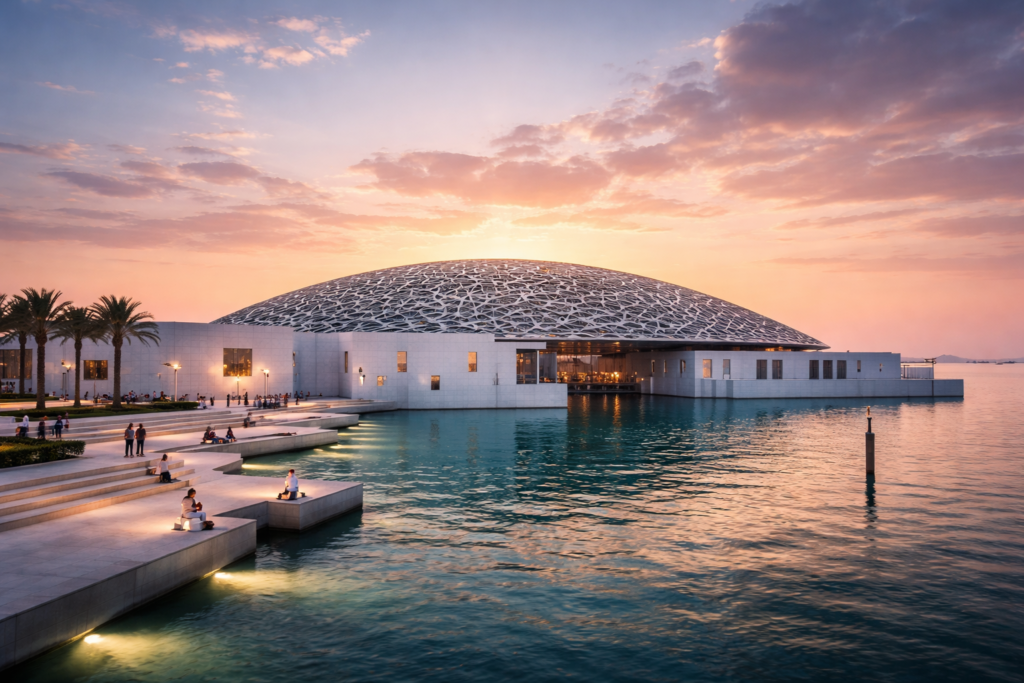
When the Louvre Abu Dhabi opened on Saadiyat Island in 2017, it redefined what a museum in the Middle East could be. Designed by Jean Nouvel, the building itself is a masterpiece: a vast perforated dome that filters sunlight into what the architect called a “rain of light” across 23 galleries and outdoor waterways. The official Louvre Abu Dhabi website outlines its permanent collection spanning thousands of years of human civilisation, from prehistoric artefacts to 21st-century art — and it is genuinely curated as a narrative, not a collection of isolated objects.
This is not a satellite of the Paris Louvre — it is its own institution with its own identity. The gallery structure traces shared histories across cultures: you will stand in front of a Mesopotamian sculpture, a Han Dynasty bronze, and a Renaissance painting within the same wing, all connected by a single human theme.
Best for: Art lovers, history enthusiasts, couples, and curious travellers who want something beyond the typical tourist tick-box.
Qasr Al Watan
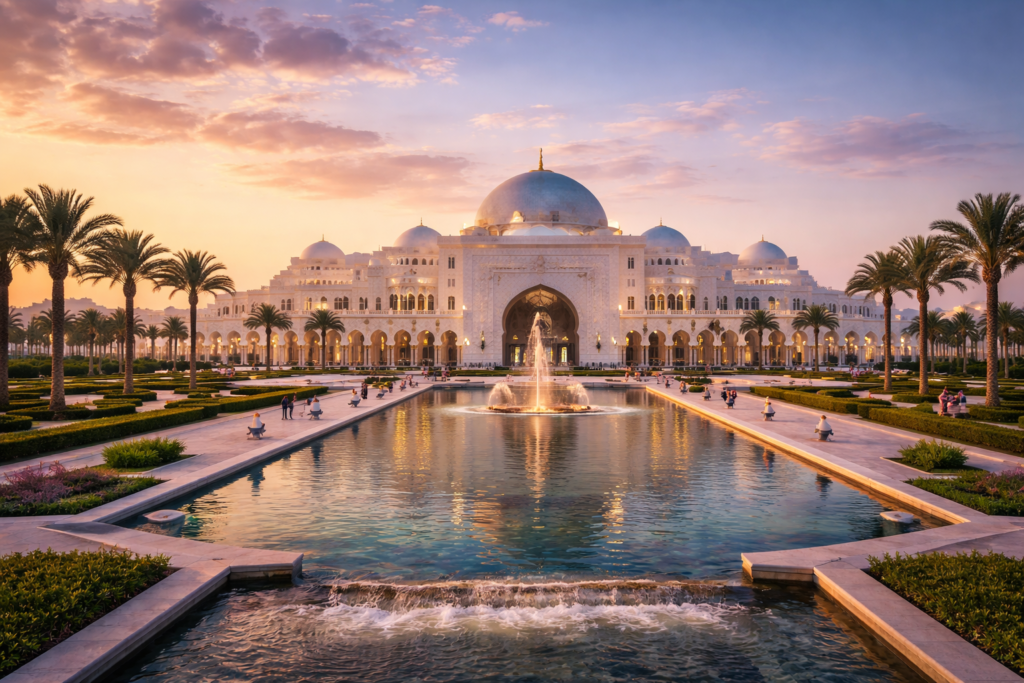
Qasr Al Watan the Palace of the Nation opened to the public in 2019 and immediately became one of Abu Dhabi’s most compelling attractions. This is a functioning presidential palace that throws open its doors for visitors, offering a rare, intimate look at the craftsmanship and ceremony behind UAE governance.
The interior is extraordinary: soaring domes hand-inlaid with geometric tilework, the Great Hall lined in Arabesque stucco, and a dedicated House of Knowledge containing rare manuscripts and artefacts. The Palace in the Sky light show after dark is one of the most spectacular free evening experiences in the city.
Pro tip: Visit at dusk to experience the palace in two lights; sunlit marble and illuminated after-dark spectacle, without needing two separate trips.
Best Cultural & Heritage Places in Abu Dhabi
Heritage Village
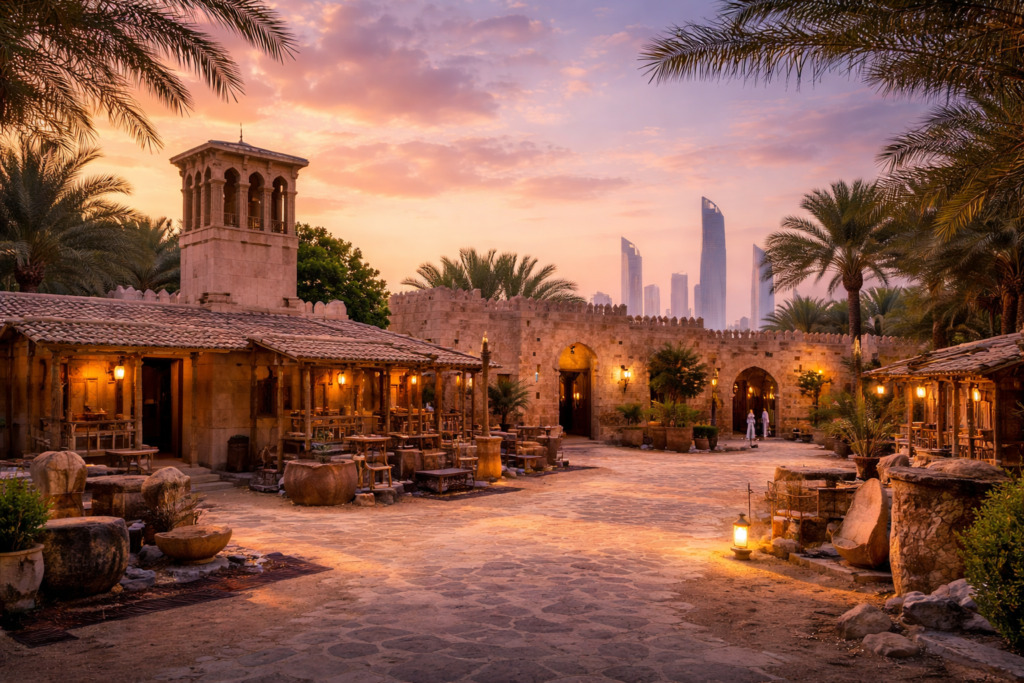
Sitting on the Corniche at Breakwater, the Heritage Village recreates traditional Emirati life with authentic detail that most tourists walk past too quickly. This is where you see how Abu Dhabi’s Bedouin ancestors lived before oil changed everything: goat-hair tents, a working falaj irrigation system, a traditional souk selling Emirati crafts, and artisans demonstrating pottery, weaving, and blacksmithing.
Entry is free, and the sea views from this spot across the Gulf are genuinely among the best in the city. It is a 45-minute visit minimum, longer if you engage with the craftspeople, who are happy to talk.
Qasr Al Hosn
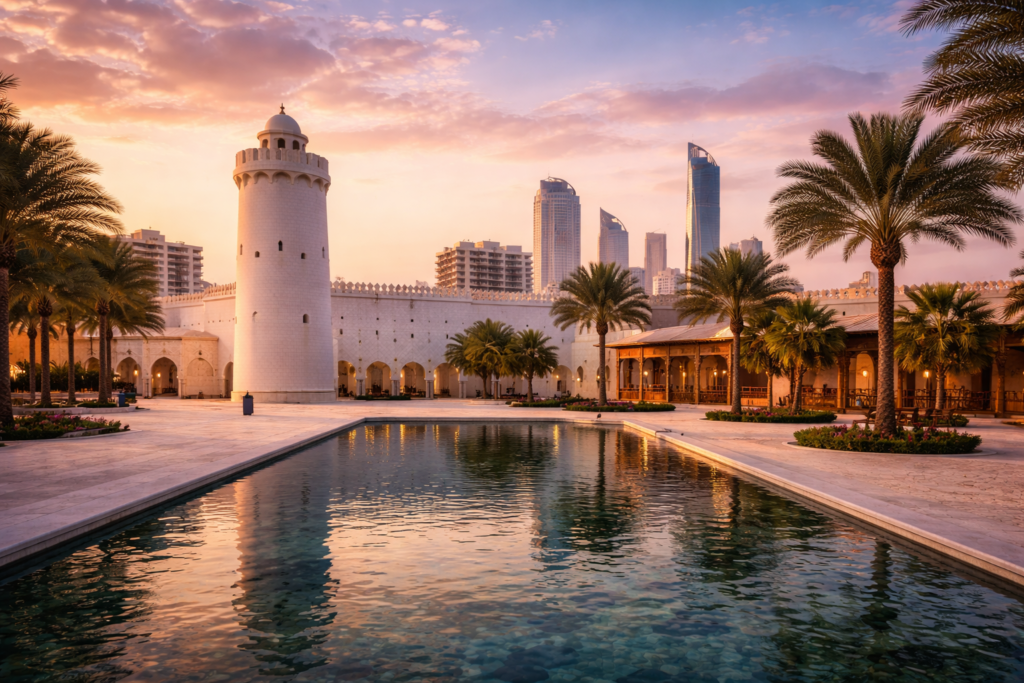
The oldest building in Abu Dhabi, Qasr Al Hosn (the White Fort), has been standing since the late 18th century and has served as a watchtower, a palace, and a seat of national government. It now functions as a museum that traces the emirate’s transformation from a pearl-diving settlement to a global city.
The fort itself is compact, but the exhibitions inside are carefully curated. The annual Qasr Al Hosn Festival, held in the courtyard each February, brings the building back to life with live performances, Emirati cooking demonstrations, and cultural displays that attract visitors from across the UAE.
Cultural Foundation
Attached to Qasr Al Hosn, the Abu Dhabi Cultural Foundation is the emirate’s primary arts hub, hosting rotating exhibitions, theatre performances, workshops, and cultural events year-round. The architecture, which blends the historic fort with contemporary gallery spaces, is an attraction in its own right. Check the programme before you visit, as the calendar changes seasonally.
Beautiful Places in Abu Dhabi for Nature Lovers
Saadiyat Island Beaches
Saadiyat Island is where Abu Dhabi keeps its best-kept natural secret: a stretch of soft white sand beach on the Arabian Gulf that is genuinely, spectacularly beautiful. The water is calm, clear, and warm from October through May. The beach is clean, well-maintained, and notably less crowded than Dubai’s more famous shorelines.
Saadiyat Beach Club is the premium option, but the public beach sections are equally beautiful and free to access. This is also a protected nesting site for hawksbill sea turtles, which come ashore from May through September, a wildlife experience entirely unlike anything else in the UAE.
Mangrove National Park
Most visitors to Abu Dhabi do not expect to encounter 75 square kilometres of intact mangrove ecosystem within the city limits. The Mangrove National Park on the eastern outskirts of the city is exactly that, a living, breathing wetland habitat accessible by kayak or paddleboard through a network of channels winding beneath the mangrove canopy.
Kayak rental operators are based at the Eastern Mangroves Promenade and guided eco-tours are available. Morning sessions are best: the light filters through the canopy, herons stand motionless in the shallows, and the whole experience feels profoundly removed from the city surrounding it.
Wildlife to spot: Greater flamingos, osprey, grey herons, mudskippers, and crab-plover.
Corniche Beach
The Abu Dhabi Corniche is the city’s living room: eight kilometres of waterfront promenade lined with parks, cafes, cycling paths, and access to a family-friendly beach that charges a modest entry fee. The beach itself is spotless, calm (protected by a breakwater), and divided into family, mixed, and male-only sections.
Walk the Corniche in either direction at sunset and you will understand why Abu Dhabi residents are genuinely proud of their waterfront. The skyline that builds behind you as you walk is one of the Gulf’s most quietly impressive.
Adventure & Entertainment Spots in Abu Dhabi
Ferrari World Abu Dhabi
Yas Island is Abu Dhabi’s entertainment district, and Ferrari World is its flagship attraction, a 200,000 square metre theme park built beneath the world’s largest architectural space frame, painted Ferrari red. The star attraction is Formula Rossa, the world’s fastest roller coaster at 240 km/h, which launches you from 0 to 240 in under five seconds. There are over 30 rides and attractions spanning all age groups, plus an authentic Italian restaurant section that is genuinely worth the detour.
Yas Waterworld
Next door to Ferrari World, Yas Waterworld is a full-day water park with 45 rides, slides, and attractions centred around an Emirati pearl-diving narrative. The Dawwama, a six-person tornado ride, is one of the world’s largest water vortex rides. The park is consistently voted among the best waterparks in the region and provides genuine value for families.
Warner Bros. World Abu Dhabi
Completing the Yas Island theme park trilogy, Warner Bros. World is the world’s largest indoor theme park fully air-conditioned and divided into six immersive lands including DC, Looney Tunes, and Cartoon Network zones. Every detail is faithful to the IP: the streetscapes, the character interactions, and the rides all feel authentically crafted rather than licensed afterthoughts. For families travelling with DC fans or kids who grew up on Cartoon Network, this is an unmissable afternoon.
Desert Experiences You Shouldn’t Miss
This is the section most Abu Dhabi guides treat as an afterthought. We are treating it as the centrepiece, because honestly? The desert is the reason to come here.
Desert Safari in Abu Dhabi
The Abu Dhabi desert is different from Dubai’s in scale, solitude, and drama. The dunes here are bigger, the stretches between civilisation longer, and the silence, when your 4×4 engine cuts out at the top of a ridge, more profound.
A proper Abu Dhabi desert safari begins in the late afternoon as temperatures soften. Your licensed 4×4, tyre pressure deliberately reduced for traction, climbs the first dune face, and you immediately understand why dune bashing is described as the region’s signature adrenaline experience.
Want to understand what that actually feels like before booking? Read our full guide:
What Is Dune Bashing Adventure?
What a full desert safari in Abu Dhabi includes:
- Dune bashing with an experienced, licensed driver
- Sandboarding down the dune faces, no experience required
- Camel riding at the desert camp
- Sunset photography from the top of the highest accessible ridge
- Traditional Bedouin camp experience: Arabic coffee, dates, henna art, and shisha
- BBQ dinner with halal and vegetarian options
- Live cultural entertainment, Tanoura spinning dance, belly dancing, and fire show under open desert skies
The Abu Dhabi Evening Desert Safari runs from late afternoon to late evening and is the most complete experience for first-time visitors. Prefer the desert at its most peaceful? The Morning Desert Safari Abu Dhabi offers cooler temperatures, golden sunrise light, and near-empty dunes, a completely different but equally powerful experience.
A Guide’s Secret for the Perfect Shot:
Don’t use all your camera battery during the midday drive. We always tell our guests to wait for the “blue hour”, the 15-minute window right after the sun dips below the horizon. Our drivers know the exact ridges to park on where the red sand of Al Khatim takes on a deep, vibrant crimson you won’t see at any other time of day.
Not sure whether Abu Dhabi or Dubai delivers the better desert experience?
Here is a quick comparison: Abu Dhabi vs Dubai Desert Safari: Battle of the Deserts
Al Khatim Desert: The Less Crowded Alternative
While many generic tours stick to the crowded inland areas, when our guides at Sahara Thrills take guests out, we specifically head to the Al Khatim Desert region southeast of the city. After years of navigating these sands, we’ve found Al Khatim offers the tallest red dunes and genuine solitude. It’s the exact landscape that professional photographers and our most serious adventure travelers specifically request.
For those wanting to push further into the UAE’s most dramatic terrain, the Liwa Desert Safari takes you to the edge of the Rub’ al Khali, the Empty Quarter, where individual dunes reach over 300 metres in height, and the horizon is nothing but sand in every direction. Liwa is genuinely one of the most extraordinary desert landscapes on earth, and it is Abu Dhabi’s most underrated experience.
Camping options in both areas are available for visitors who want to wake up in the desert, watch the Milky Way materialize overhead without light pollution, and greet the sunrise over a dune ridge with a cup of Arabic coffee. Few experiences in travel match it.
Hidden Gems & Unique Places in Abu Dhabi
These spots rarely make it onto standard tourist lists. They absolutely should.
Al Wathba Fossil Dunes: Located 45 minutes from the city, Al Wathba’s limestone formations have been sculpted over millennia into surreal, wave-like pillars that look genuinely alien. Entry is free, the landscape is extraordinary, and it draws almost no visitors on weekday mornings. Bring a camera and comfortable shoes.
Al Quaa Milky Way Spot: Deep in Abu Dhabi’s southern desert region, far from any light pollution, Al Quaa has become quietly famous among astrophotographers as one of the darkest sky locations in the Arabian Peninsula. The Milky Way here is visible to the naked eye on clear nights, within arm’s reach. Desert camping combined with stargazing in this area produces nights that travellers describe as life-changing without any exaggeration.
Jubail Mangrove Walk: A free, 2.5-kilometre boardwalk built through the mangroves north of Abu Dhabi, Jubail Mangrove Park requires no booking or kayak. You simply walk through the ecosystem at ground level, close enough to the water to spot stingrays drifting in the shallows below the boards. It is one of the genuinely undiscovered gems of UAE nature tourism.
Free & Budget-Friendly Places to Visit in Abu Dhabi
Abu Dhabi has a well-deserved reputation for luxury, but significant portions of it are entirely free.
- Sheikh Zayed Grand Mosque: Free entry for all visitors
- Corniche Beach: The public sections are free; the family beach charges a very modest fee
- Heritage Village: Free entry, free parking
- Qasr Al Watan light show: Free to view from outside the palace gates
- Jubail Mangrove Walk: Free access, no booking required
- Al Wathba Fossil Dunes: Free natural attraction
- Abu Dhabi Corniche promenade: Free walking, cycling, and sea views
- Cultural Foundation exhibitions: Many are free or very low cost
Budget travellers should also note that Abu Dhabi’s public bus network is reliable and cheap, and most major attractions cluster in three zones (Corniche area, Yas Island, Saadiyat Island) that can be covered cost-effectively with a hire car for a day.
Best Places to Visit in Abu Dhabi with Family
Abu Dhabi is genuinely one of the most family-accommodating destinations in the world — not as a marketing claim, but in practical terms. Distances between major attractions are short. Facilities are consistently excellent. And the activity variety covers every age from toddler to teenager.
Top family picks:
- Ferrari World, Yas Waterworld, and Warner Bros. World: The Yas Island trio is a full two-day commitment for families with children of any age
- Corniche Beach: Calm, clean, supervised, with cafes and playgrounds immediately adjacent
- Heritage Village: Older children engage well with the craft demonstrations and historical context
- Mangrove kayaking: Suitable from approximately age 6, with tandem kayaks for younger children
- Desert safari: Most operators (including Sahara Thrills) accommodate children comfortably, with the camel ride and camp entertainment being particular highlights for kids
The Abu Dhabi City Tour with Sahara Thrills covers the major landmarks in a single guided day with hotel pickup included a practical option for families who want expert context without the logistics of driving unfamiliar roads.
Best Time to Visit Abu Dhabi Attractions
Abu Dhabi’s weather divides cleanly into two seasons, and timing your visit correctly makes an enormous difference.
October to April (the ideal window) Temperatures range from 18°C to 28°C warm, sunny, and genuinely comfortable for outdoor exploration. This is when the Corniche beach, the Heritage Village, outdoor markets, and desert safaris are all operating at their best. December and January occasionally bring light rain, but nothing that meaningfully disrupts travel plans.
May to September (summer) Temperatures climb between 38°C and 45°C, with high humidity from June onwards. Outdoor attractions like beaches and heritage sites are uncomfortable in the midday heat, but indoor attractions (the Louvre, Warner Bros. World, Ferrari World, and the mall-based experiences) operate year-round regardless of temperature. Desert safaris during the summer months start at dawn to avoid the midday heat.
For desert experiences specifically, our detailed breakdown covers everything you need to know: Best Time for Desert Safari: 2026’s Guide.
Peak vs off-peak: November through March is the busiest period. Booking ahead for popular desert safaris and the Yas Island theme parks is strongly recommended during UAE national holidays and school breaks.
Recommended 2–3 Day Abu Dhabi Itinerary
Day 1: Cultural Abu Dhabi
Morning: Sheikh Zayed Grand Mosque; arrive at 9 am before tour groups. Allow 90 minutes minimum.
Late morning: Drive to Qasr Al Hosn for the fort museum, then walk to the Cultural Foundation next door.
Afternoon: Heritage Village for an hour, then stroll the Corniche promenade with a stop at a waterfront cafe.
Evening: Qasr Al Watan for the Palace in the Sky light show after sunset.
Day 2: Islands & Entertainment
Morning: Louvre Abu Dhabi on Saadiyat Island, open from 10am, plan two to three hours.
Lunch: Saadiyat Beach, picnic or beachside restaurant, then swim for an hour or two.
Afternoon/Evening: Yas Island; choose one or two theme parks depending on your group (Ferrari World for thrill-seekers, Warner Bros. World for families with younger children, Yas Waterworld if the heat allows).
Day 3: Desert Safari
This is the day that makes the trip. Head out in the late afternoon for a full abu dhabi desert safari experience: dune bashing, sandboarding, camel riding, sunset photography, traditional Bedouin camp dinner, and live entertainment under an open desert sky. Return to the city around 10 pm with memories that no city-based itinerary produces.
If your schedule allows extending this into an overnight, the experience of sleeping in a Bedouin-style camp and watching the Milky Way overhead from the desert is genuinely irreplaceable.
Tips for Exploring Abu Dhabi
Getting around: The city is best explored by hire car or taxi; public buses are available but routes require planning. Careem and Uber both operate widely. For the desert, always go with a licensed operator using RTA-approved vehicles.
Dress code: Abu Dhabi is more conservative than Dubai. Cover your shoulders and knees in public spaces, malls, and mosques. Swimwear is fine at the beach and pool, but not on the street. Abayas are available to borrow at mosque entrances.
Budget tips:
- Free attractions genuinely rival the paid ones — plan for both
- Eating at local Emirati and South Asian restaurants on and around Hamdan Street saves significantly versus tourist-area dining
- Book desert safaris directly through operators like Sahara Thrills rather than hotel desks — you pay considerably less for the same experience
Book ahead: The Yas Island theme parks get genuinely crowded on weekends and public holidays. Booking desert safaris at least 24 hours in advance is wise from October to April.
Photography: Abu Dhabi is extraordinarily photogenic, but always ask permission before photographing local people, and do not photograph government buildings, military installations, or royal residences.
Final Thoughts
Abu Dhabi rewards the visitor who arrives with curiosity rather than a checklist. Yes, the Sheikh Zayed Grand Mosque is every bit as astonishing as the photographs suggest. Yes, the Louvre is worth every minute. And, yes, Yas Island delivers theme park experiences that compete with anything in Asia or Europe.
But the version of Abu Dhabi that stays with you longest, the one that comes back to you weeks later when you are in a meeting or stuck in traffic, is the desert at sunset. That first view from the top of a dune ridge, with nothing between you and the horizon except 300-metre walls of red sand glowing in the last light of the day, is the kind of moment that fundamentally recalibrates your sense of scale.
Do not leave Abu Dhabi without experiencing it.
Make your trip complete by booking a desert safari experience in Abu Dhabi with Sahara Thrills, Book your Abu Dhabi desert safari here and we will handle everything, from hotel pickup to the stars above your desert camp.
Frequently Asked Questions
What are the best places to go in Abu Dhabi?
The top places include Sheikh Zayed Grand Mosque, Louvre Abu Dhabi, Qasr Al Watan, Saadiyat Island, the Yas Island theme parks, and the Abu Dhabi desert for safari experiences. Each covers a completely different side of the emirate, so a 2–3 day visit gives you a genuine cross-section.
What are the must-see attractions in Abu Dhabi?
The Sheikh Zayed Grand Mosque is non-negotiable. Beyond that, the Louvre Abu Dhabi for culture, Yas Island for entertainment, and a desert safari for the experience that no other destination replicates. These three together define what Abu Dhabi actually is.
Are there free places to visit in Abu Dhabi?
Yes — and excellent ones. Sheikh Zayed Grand Mosque, Corniche Beach (public section), Heritage Village, Al Wathba Fossil Dunes, and the Jubail Mangrove Walk are all free. The Qasr Al Watan evening light show can also be viewed from outside the palace gates at no cost.
Is Abu Dhabi good for tourists?
Consistently one of the top-rated destinations in the Middle East for visitor satisfaction. It is safe, clean, logistically well-organized, and offers a range of experiences spanning culture, luxury, nature, family entertainment, and adventure that few cities its size can genuinely match.
What is the most beautiful place in Abu Dhabi?
Different visitors answer this differently. Architecture lovers point to the Sheikh Zayed Grand Mosque. Nature lovers choose the Mangrove National Park or Saadiyat Island beaches. Desert travellers describe the Liwa dune fields as the most viscerally beautiful landscape they have encountered anywhere. All three answers are correct.
How many days are enough to explore Abu Dhabi?
Two to three days covers the major attractions comfortably. A minimum of one full day for the cultural landmarks, one day for islands and entertainment, and one afternoon-into-evening for the desert safari gives you a properly rounded picture of what Abu Dhabi is.
